Why Your EV Charger Needs Its Own Dedicated Circuit (Real Baltimore Job Photos)
We pulled a melted range receptacle out of a garage that was being used to charge an EV. Here's why continuous 40A load destroys shared circuits, and what a code-compliant NEMA 14-50 install actually looks like.
This is a real receptacle we removed today. It was being used to charge an electric vehicle on an existing range circuit. Another few weeks and this was a garage fire.
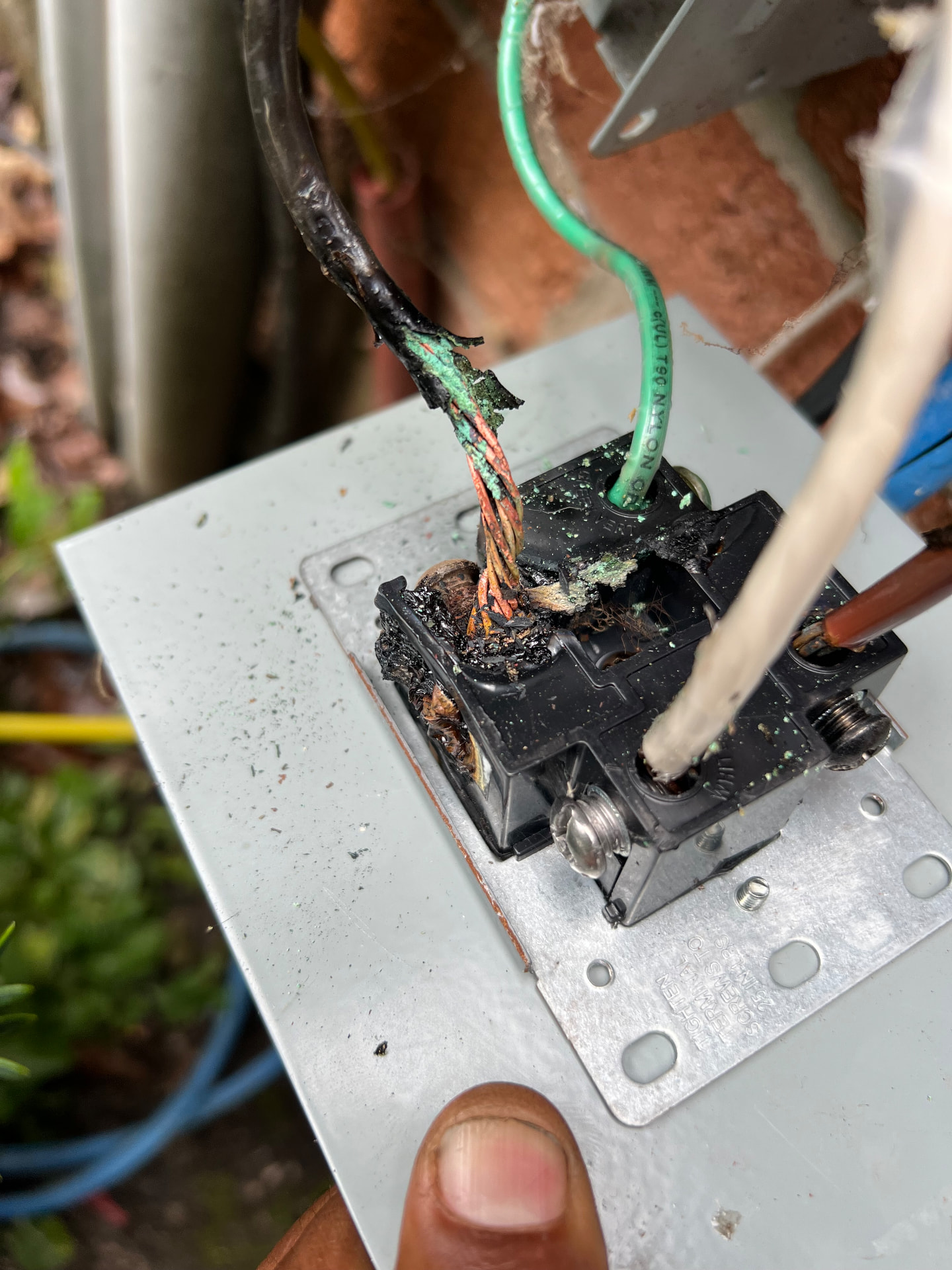
Every week somebody asks us if they can just plug their car into the dryer or stove outlet that's already in the garage. Technically the plug fits. Electrically, it's a completely different job — and this photo is what happens a few months later.
EV charging is a continuous load. Appliances are not.
A stove pulls big amperage in short bursts. An EV pulls 32 to 48 amps steadily for eight to ten hours, night after night. The National Electrical Code calls that a continuous load and requires the circuit to be sized at 125% of the charging current — that's why a 40A charger needs a 50A breaker and correctly sized copper. A receptacle that was fine for Thanksgiving dinner cooks itself when you ask it to hold full current all night.
How the failure actually happens
- Terminals heat and cool every cycle until the screws back off
- Loose terminal = resistance = more heat, and it snowballs
- The receptacle body chars, then the insulation, then the box
- Arcing starts inside the enclosure — usually behind drywall or in a garage full of stuff
What a correct install looks like
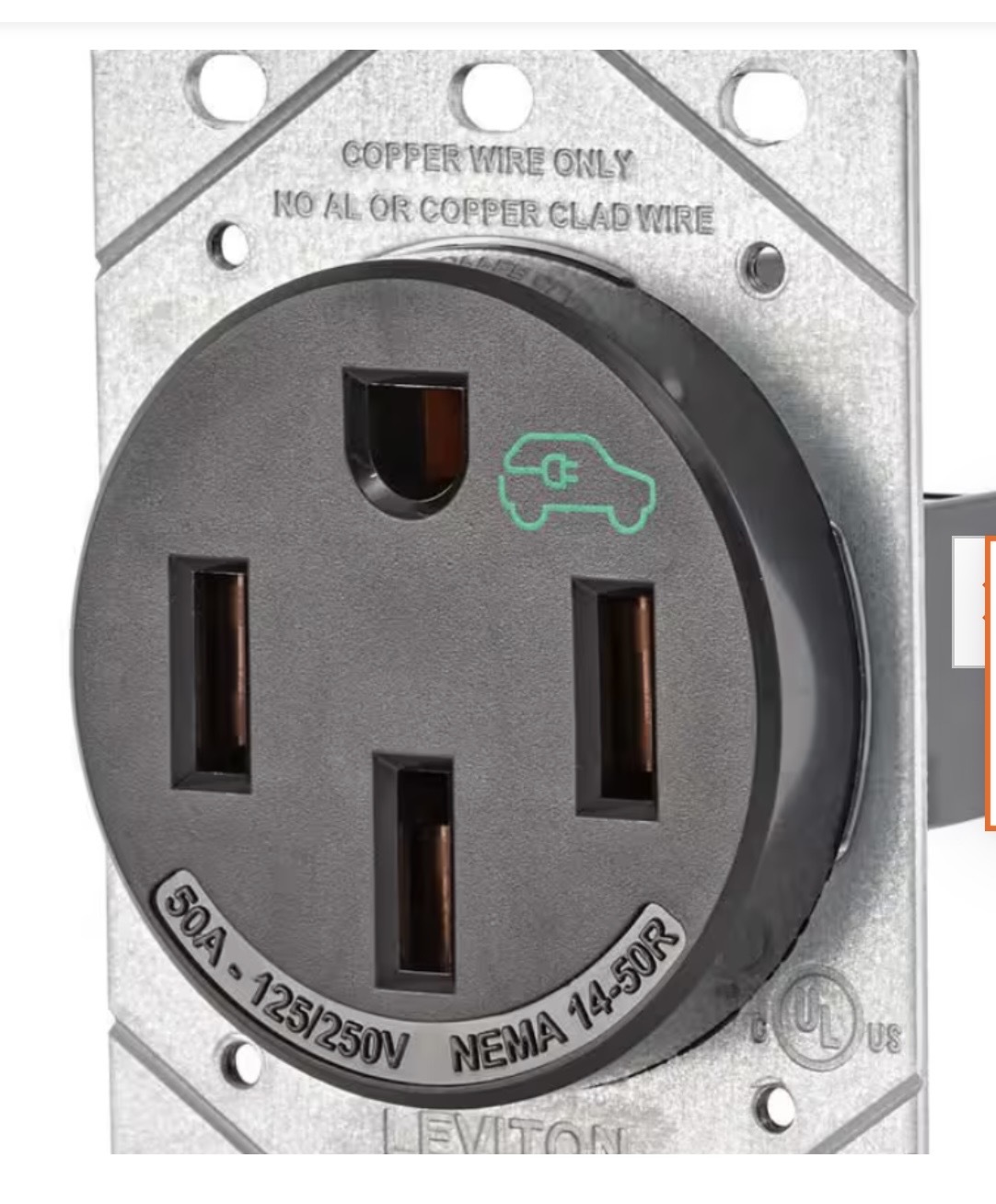
- Its own breaker in the panel — nothing else shares it
- 50A double-pole breaker for a 40A charger (NEC 625 continuous-load rule)
- Correctly sized copper conductors — no aluminum, no copper-clad, on a 14-50 marked COPPER WIRE ONLY
- GFCI protection where required, and a proper equipment ground
- Industrial-grade receptacle — the $12 builder-grade ones are the ones that melt
- Permit pulled and inspected, so your insurance holds up
Hardwiring the charger instead of using a plug is often the better choice for daily charging — fewer connections to loosen, and it removes the receptacle as a failure point entirely.
Things we will not do
- Split or piggyback an existing range or dryer circuit
- Install a 14-50 on undersized wire because 'it only charges at night'
- Use a splitter or adapter so the dryer and the car share one plug
- Skip the permit
Do I have panel capacity?
Most homes in Baltimore City and Baltimore County with a 200A service can add a 50A EV circuit with no problem. Older 100A services often need a load calculation, and sometimes a service upgrade or a load-management device. We check that before we quote — no surprises on install day.
Free estimates on EV charger installs across Baltimore City, Baltimore County and Howard County. Licensed, insured, woman-owned, 3-year warranty. Call (443) 529-4541 or book online.